
Satellite reception is built around a number of technical settings that allow a receiver to identify a television broadcast and add it to the available channel list.
When broadcasters make changes to these settings, the previous channel information may become outdated. This is one of the common reasons why viewers sometimes lose access to channels they have been watching regularly.
Fortunately, updating a receiver does not always require professional assistance. Using the manual installation function, viewers can enter the appropriate information and perform a fresh scan to look for the desired service.
In the following sections, we provide a practical guide dedicated to the featured channel, covering the information needed before starting the search and the main steps for adding it successfully. The instructions are presented in a simple format suitable for everyday satellite TV users.
The Astra 28.2°E satellite position is one of the most important satellite positions for viewers in the United Kingdom. It carries a wide range of British tv and radio services and is closely associated with popular satellite platforms such as Sky and Freesat.
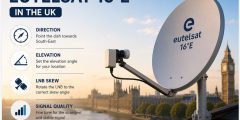
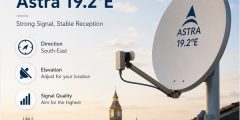
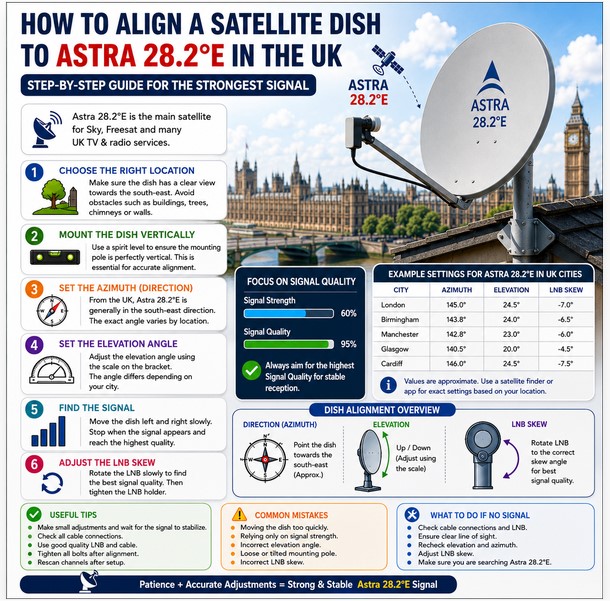
Whether you are installing a new satellite dish, replacing an old LNB or trying to improve a weak transmission, accurate dish positioning is essential. Even a small movement can affect reception, so setting the correct direction, elevation and LNB angle is the key to achieving a strong and steady transmission.
This guide explains the correct way to align a satellite dish to Astra 28.2°E in the UK.
Choose the Best Location for the Satellite Dish
Before adjusting the dish, make sure it is installed in a suitable location.
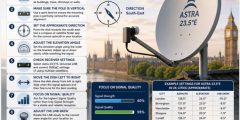
The dish needs a sharp line of sight toward the satellite. In the UK, an Astra 28.2°E dish generally points toward the south-east.
Avoid installing the dish where the transmission path is blocked by:
- Tall buildings.
- Trees and large branches.
- Chimneys.
- Walls.
- Nearby structures.
A sharp view is essential because even a relatively small obstacle can block or weaken the satellite transmission.
Make Sure the Mounting Pole Is Perfectly Vertical
One of the most common causes of positioning problems is an incorrectly installed mounting pole.
Before making any adjustments, use a spirit level to make sure the pole or wall bracket is completely vertical.
This is important because the elevation markings on the satellite dish bracket are only accurate when the mounting pole is perfectly vertical. If the pole is leaning, the elevation setting will not provide the expected results.
Understanding the Astra 28.2°E Dish Direction
The Astra 28.2°E position is located east of the UK, but this does not mean that the dish should point directly east.
From the United Kingdom, the dish normally points toward the south-east, although the exact direction varies depending on your location.
For example, the required azimuth will be slightly different in:
- London.
- Birmingham.
- Manchester.
- Liverpool.
- Glasgow.
- Edinburgh.
- Cardiff.
- Belfast.
The further your configuration location changes, the more the azimuth and elevation settings can vary.
For this reason, it is always best to use a satellite positioning calculator or satellite finder application based on your exact location.
Setting the Correct Elevation Angle
The elevation angle determines how high above the horizon the satellite dish should point.
In southern parts of the UK, the elevation angle is generally higher than in northern areas. This means a dish installed in London will not necessarily use the same elevation setting as a dish installed in Scotland.
Use the elevation scale on the dish bracket as a starting point, then make small adjustments while monitoring the transmission clarity.
When adjusting the elevation:
- Loosen the elevation bolts slightly.
- Set the approximate angle.
- Move the dish upward or downward very slowly.
- Wait for the device to update the transmission reading.
- Stop when the highest transmission clarity is reached.
Avoid making large movements. A small adjustment can make a significant difference.
Aligning the Dish from Left to Right
After setting the approximate elevation, slowly move the dish horizontally to search for the satellite.
Move the dish from left to right in very small steps.
When the device detects a transmission:
- Stop immediately.
- Wait for the transmission clarity to stabilize.
- Continue making very small adjustments.
- Find the position with the highest transmission clarity.
Do not move the dish too quickly. Satellite receivers can take a few seconds to update the transmission meter, so moving too fast can cause you to pass the correct satellite position.
Focus on Signal Quality, Not Only Signal Strength
Many receivers display two different measurements:
- Signal Strength.
- Signal Quality.
Signal strength only shows that the device is detecting a transmission from the LNB. It does not always confirm that the dish is pointing at the correct satellite.
Signal clarity is more important because it indicates that the device is successfully decoding the transmission.
When aligning Astra 28.2°E, always try to achieve the highest possible Signal Quality rather than focusing only on transmission strength.
Adjusting the LNB Skew
The LNB must also be positioned correctly.
The LNB skew is the angle at which the LNB is rotated inside its holder. The correct angle changes depending on your location in the UK.
After finding the Astra 28.2°E transmission:
- Loosen the LNB holder slightly.
- Rotate the LNB very slowly.
- Monitor the transmission clarity.
- Stop when the highest clarity is achieved.
- Tighten the holder securely.
Only small movements should be necessary. An incorrect LNB angle can reduce transmission clarity and make reception less reliable during bad weather.
Can You Use an Old Sky Dish for Astra 28.2°E?
In many cases, an old Sky satellite dish can still be used for Astra 28.2°E because it was originally designed for reception from the same general satellite position.
However, the configuration may require additional work if:
- The dish has been moved.
- The LNB is damaged.
- The cable is old or corroded.
- The LNB type is incompatible with your device.
- The dish has been incorrectly aligned.
If the dish has been untouched and is still properly positioned, you may only need to check the LNB, cable and device settings.
What to Do If There Is No Astra 28.2°E Signal
If your device shows no transmission, check the following:
- Make sure the satellite cable is securely connected.
- Inspect the LNB for visible damage.
- Check the cable for cuts, cracks or water damage.
- Make sure the device has the correct LNB settings.
- Check that the dish has a sharp line of sight.
- Confirm that the mounting pole is vertical.
- Recheck the elevation angle.
- Move the dish slowly from left to right.
- Adjust the LNB skew.
- Make sure you are searching for the correct satellite.
If a transmission appears but the expected channels are missing, the dish may be pointed at a different satellite position.
Common Mistakes When Aligning Astra 28.2°E
Several common mistakes can prevent successful satellite reception.
Moving the Dish Too Quickly
Fast movements can cause you to miss the satellite. Always make small adjustments and wait for the transmission meter to update.
Using the Wrong Signal Meter
Some users rely only on transmission strength. Always check transmission clarity to confirm successful reception.
Ignoring LNB Position
A poorly adjusted LNB can reduce reception clarity even when the dish is correctly aligned.
Incorrect Mounting Pole
A tilted pole can make the elevation scale inaccurate and make the positioning process much more difficult.
Tightening the Bolts Too Early
Do not fully tighten the dish before completing fine adjustments. Leave the bolts slightly loose until the highest possible transmission clarity has been found.
How to Get a Stronger and More Stable Astra Signal
For the best results, follow these recommendations:
- Use a suitable satellite dish for your location.
- Install the dish on a strong and steady mount.
- Use a good-clarity LNB.
- Replace damaged or old cables.
- Keep the cable connections protected from moisture.
- Avoid unnecessary cable joins.
- Maintain a sharp line of sight to the satellite.
- Adjust the dish in very small movements.
- Focus on transmission clarity.
- Check the transmission again after tightening all bolts.
Final Check After Aligning the Dish
After reaching the best transmission clarity, carefully tighten all mounting bolts.
Tightening the bolts can slightly move the dish, so check the transmission meter again after each bolt is secured.
Once the dish is fully tightened, perform a channel search on your device.
If the expected Astra 28.2°E services are found and the transmission remains steady, the configuration has been successfully completed.
Why a Lightning Protector Is Important for a Satellite Dish System
- A suitable lightning protection system can help reduce the risk of electrical surges reaching sensitive satellite equipment.
- Outdoor satellite cables can provide a path for induced electrical surges during nearby lightning activity.
- Proper grounding and bonding are essential components of a safer satellite installation.
- Lightning protection equipment should be installed according to applicable electrical safety standards and manufacturer instructions.